February 2, 2026
I’ve been thinking about resettling, about claiming or being claimed by a place, about what’s hard in that, and what can be good. Not everyone gets to choose where they live, and some individual choices are denied. So often, there’s no way of going back. And sometimes it looks or feels like it’s the place making the choice.
The last few months, across the turn of the year, I’ve been reading One Man’s Meat, a collection of monthly posts written by E. B. White from 1939 to 1943, written mostly from his place in Maine, and mailed off to Harper’s. (Later on, White became famous for his children’s books, including Charlotte’s Web—but these posts were written for adults.)
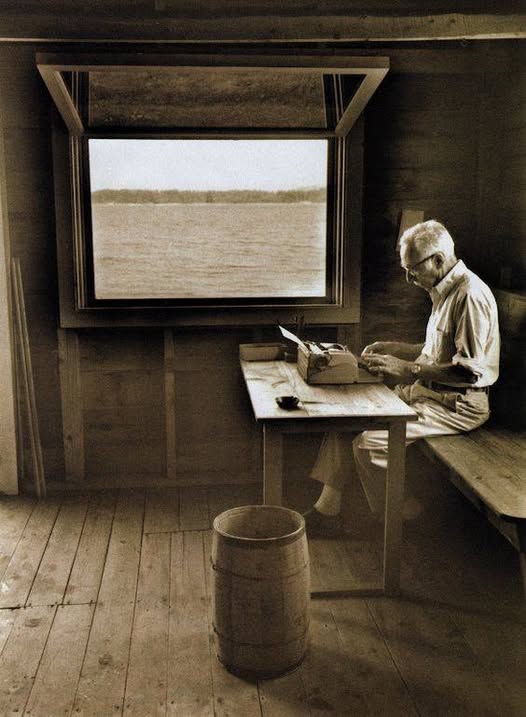
Through the years described in these posts, the United States watched alarming, heartbreaking events in Europe, and tried to decide how to respond—ultimately entering World War II. Meanwhile, Andy White had decided that he would uproot his small family from New York City; that he and his wife would continue to work for The New Yorker, but from afar, from a saltwater farm in Maine; that they would also grow some of their own food, and produce food for others.
(This photo, from the book’s cover, was taken years later by Jill Krementz.)
I felt drawn to the book by a coincidence. In exactly those same years, when my mother was turning twelve, her parents decided to buy a farm in Maine. Alarmed by the events in Europe, they wanted a refuge, where they could grow some of their own food. (Yes, an echo.) They didn’t fully uproot themselves from Massachusetts, where my grandfather ran an iron foundry, but they became deeply involved with the village in which they spent spring weekends planting, summers tending and weeding, and fall weekends harvesting.
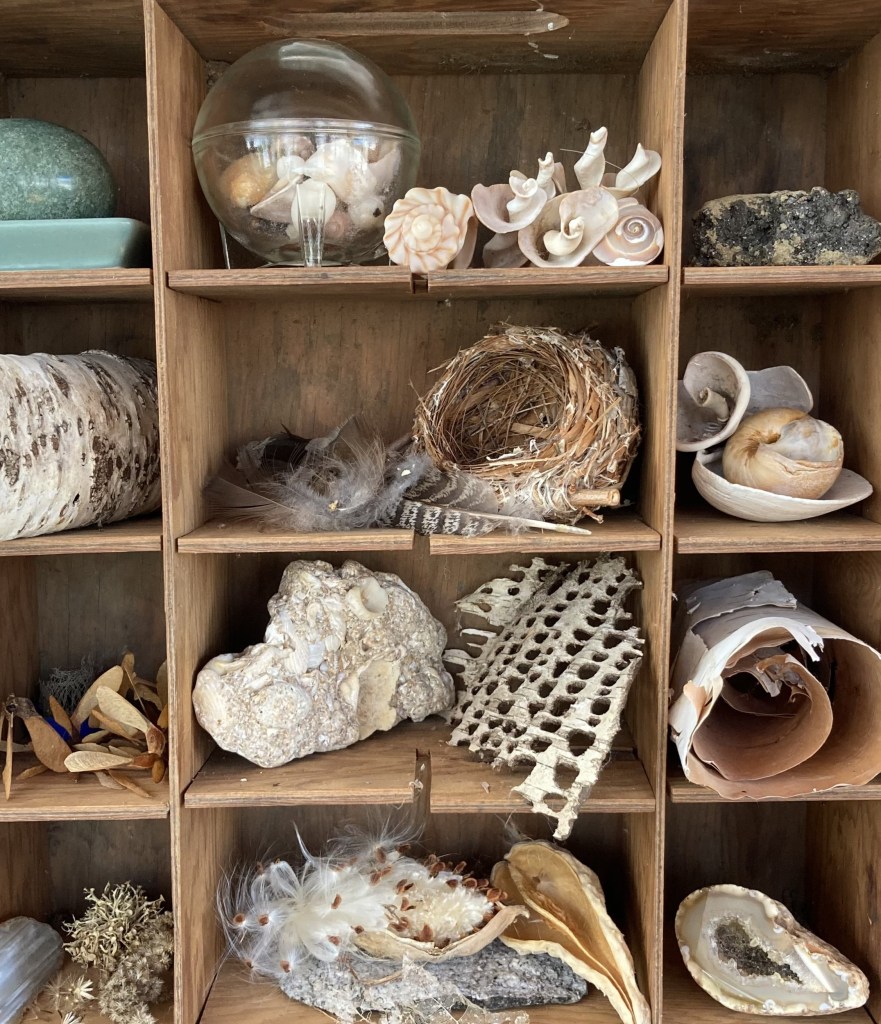
Throughout the war and its shortages, they carried back to Massachusetts enough vegetables for four families. The photo to the right shows one of the plywood boxes my grandfather built for carrying jars of preserved food, in this case jams and jellies. I’ve rescued one box from the stack in the barn, and removed a divider, and I use the cubbyholes to juxtapose treasures.
White’s posts often bounce from what’s happening in his henhouse or his sheep pasture to what’s happening in France—and then back again. As a reader, I feel sympathetic on several levels. I identify with the challenges of any physical enterprise in the unpredictability of Maine’s weather. (These are often described with wry humor.) I also identify with White’s very serious effort to understand what needed changing in the human culture of our world, to make it livable for all its people.
So: now I turn to my own resettling in Maine, and to some choices that have grown out of that, including this new website, pollybrownpoet.com. Its main point is poetry, the writing, the books, the other writers and communities who’ve nourished and challenged and sustained me, many of them now far away.
Sharing all that feels essential, somehow, at this stage in my own voyage. I also suspect that this blog may bounce, as White’s posts did, even within the same post, back and forth between various things that may not be obviously related.
We keep losing fellow poets who’ve mattered to me, and I may write about them.
Having decided to create my own website, I may want to write about the craziness of that process. Every page has been fertilized with piles of swearing—but it’s been interesting to watch myself as a learner who is easily stopped in her tracks, but ultimately persists, often with help from friends.
Then there’s Stitching, the new collection of poems that lit the fire under this whole effort. Elsewhere on the website you can read sample poems or listen to me reading them aloud. Here, I may want to write about the ways hatching a book resembles pregnancy (or farming); or the ways promoting a book resembles sending a child to school, never sure who you’re sending out the door or who will return.
I probably will not write about how to compose and revise a poem. I’m never sure. I have to rediscover it all, again and again, working with each poem through many drafts. But that may be the way this blog resembles the blog about teaching that I wrote after I retired, ayeartothinkitover.com—because my teaching was full of invention and discovery—both on my own and in collaboration with students, parents, and fellow teachers.
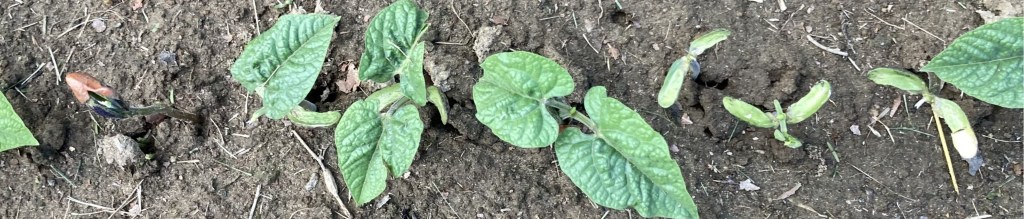
Is it all about the joyful work of learning, one way and another? In the same soil my grandparents farmed, I am growing tiny crops of beans, sunflowers, oregano. And some poems. The beans are a token, I know, but they mean a lot to me.
So, readers out there, all three or four of you: may your lives go well and may your tribe increase. I welcome the collaboration of comments, questions, suggestions. As always, I take a deep bow toward anyone who’s read this far—and I send, from the chilly north, my warmest thanks.
To get an email notification for new posts:


Leave a Reply